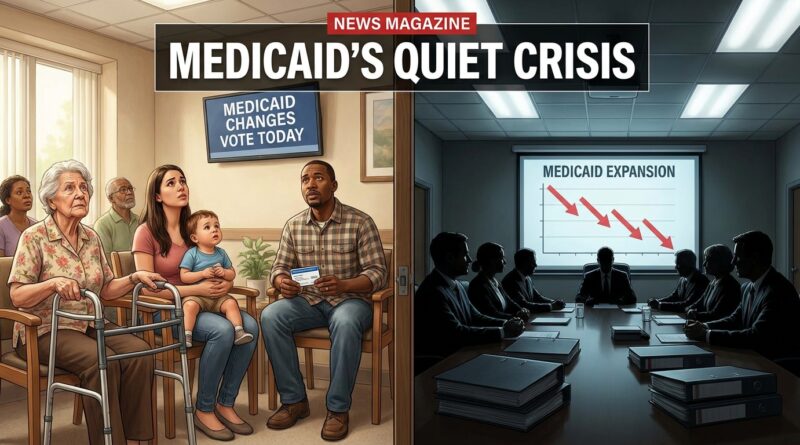
Will Your State Quietly Roll Back Medicaid? Inside the New Push To Shrink Health Coverage For Millions
You are not imagining it. Health care officials keep saying Medicaid is still there, but in several states the real fight has moved into budget footnotes, trigger laws, waiver requests, and ballot wording so dry most normal people would never click on it. That is exactly why this matters. A Medicaid expansion rollback 2026 push does not always show up as a loud headline saying “we are cutting coverage.” It often arrives as a funding cap, new work rules, higher renewal hurdles, or a plan to freeze enrollment and let coverage slowly shrink. For families, that can mean fewer doctor visits, bigger ER bills, longer waits for nursing care, and more stress every time a renewal notice shows up in the mail. If your household uses Medicaid directly, or relies on a hospital, clinic, nursing home, or children’s program that depends on it, this is not abstract politics. It is about whether coverage still works when someone gets sick.
⚡ In a Hurry? Key Takeaways
- Yes, some states are testing ways to roll back or weaken Medicaid expansion in 2026, often through budget language and rule changes rather than blunt public votes.
- Check your state legislature site, Medicaid agency notices, and ballot summaries now. Look for phrases like work requirements, enrollment freeze, cost sharing, trigger law, waiver, and eligibility redetermination.
- Even if you are not on Medicaid, cuts can hit local hospitals, prenatal care, nursing homes, and kids’ care. The ripple effects reach far beyond one insurance card.
Why this is happening now
States are under budget pressure. Federal pandemic-era funding has faded. Political leaders who never liked Medicaid expansion are looking for quieter ways to trim it without taking full blame.
That is the key point. A lot of officials know “ending health coverage for working families” is a hard sell. So instead of saying that out loud, they may use softer phrases like “program integrity,” “cost containment,” “community engagement,” or “fiscal sustainability.” Those words can sound harmless. Sometimes they are not.
In plain English, the current Medicaid expansion rollback 2026 push often means one of three things. Make fewer people qualify. Make it harder to stay enrolled. Or keep the program on paper while cutting what it actually covers in practice.
What Medicaid expansion actually does
Medicaid expansion lets more low-income adults qualify for health coverage, including many people who work but do not get affordable insurance through a job. That includes retail workers, home health aides, gig workers, restaurant staff, part-time workers, caregivers, and adults between jobs.
If a state rolls that back, the people most likely to feel it first are adults without children, parents whose income bounces up and down, and people doing seasonal or contract work. The loss may not be immediate for every person. Sometimes it starts as more paperwork, more frequent eligibility checks, or new premiums that look small on paper but are enough to knock someone off coverage.
How states may try to shrink coverage without saying “cut”
Work requirements
This is one of the oldest ideas in the stack. Supporters call it a fairness rule. In real life, many people on Medicaid already work, care for family, are disabled, or move in and out of unstable jobs. Work requirements mostly create paperwork traps. Miss a form, lose coverage.
Enrollment freezes
A state may keep current members but stop new people from joining, or limit enrollment when funding hits a cap. That sounds technical. It means someone who loses a job next year may find the door partly shut.
More frequent renewals
Instead of renewing coverage smoothly, states can require more checks, more mail notices, and tighter deadlines. People lose coverage not because they stopped qualifying, but because they missed a letter, moved apartments, or could not get through on the phone.
Premiums and cost sharing
Even small monthly charges can push very low-income households out. A $10 or $20 bill does not look like much in a hearing room. It feels very different when you are choosing between gas, groceries, and medicine.
Section 1115 waivers
This is the policy version of “special permission.” States can ask the federal government to approve experiments in how Medicaid runs. Some waivers are reasonable. Others are used to test barriers that reduce enrollment.
Trigger laws and automatic rollbacks
Some states tie expansion to future funding formulas or budget conditions. If federal support changes, or if state leaders claim a shortfall, rollback plans can kick in with less drama than a straight repeal vote.
What this means for your family, not just “the system”
Policy talk gets fuzzy fast, so bring it back to daily life.
If your child sees a pediatrician through Medicaid, a rollback can mean delayed checkups or more time hunting for a clinic that still accepts your plan.
If your parents need long-term care, the strain on Medicaid dollars can spill into nursing home staffing, waitlists, and support services.
If you are on expansion coverage yourself, losing it can push you toward being uninsured, going without prescriptions, or using the ER for care you would have handled earlier and cheaper in a doctor’s office.
Even people with employer insurance are not insulated. Rural hospitals and safety-net clinics depend heavily on Medicaid payments. When coverage shrinks, local care options can shrink too.
Red flags to watch for in your state
You do not need to read every 200-page budget bill. You do need to watch for certain phrases.
- “Community engagement” or “employment and training requirements”
- “Eligibility verification improvements”
- “Enhanced redeterminations”
- “Per-capita cap” or “global budget target”
- “Cost sharing reforms”
- “Enrollment cap” or “waitlist authority”
- “Sunset” or “trigger” tied to federal funding
- “Waiver request” to redesign benefits or eligibility
If you see those phrases in a bill summary, hearing agenda, or ballot explanation, slow down and read more. That is often where the real change is hiding.
How to check whether your state is moving toward a rollback
1. Look at your state legislature website
Search the terms Medicaid, expansion, waiver, eligibility, work requirement, and appropriations. Committee pages matter because budget changes often start there, not on the evening news.
2. Read the Medicaid agency’s public notices
Every state Medicaid program posts notices for major changes, waiver proposals, and comment periods. These pages are usually ugly and hard to read. Annoying, yes. Still worth it.
3. Watch ballot summaries, not just campaign ads
If a measure reaches voters, the summary language may be much narrower or murkier than the ads around it. Read the actual text. If the wording talks about “state flexibility” or “budget guardrails,” ask what coverage changes that allows.
4. Call a local navigator or legal aid group
You do not have to figure this out alone. Health care navigators, hospital financial counselors, legal aid offices, and consumer groups often know what a proposal would do before the average resident hears about it.
Questions to ask before a rollback gets baked in
Here are the plain-English questions that cut through the fog:
- Will fewer people qualify for Medicaid than they do today?
- Will current members have to file more paperwork to stay covered?
- Will adults lose coverage if they miss a deadline or reporting rule?
- Are premiums or copays going up for very low-income residents?
- Will hospitals, clinics, mental health providers, or nursing homes lose funding?
- Is this change temporary, or is it a back-door permanent rollback?
If lawmakers cannot answer those clearly, that is a warning sign by itself.
What you can do if you are worried
Speak up early
Once a budget is signed, reversing it is hard. Public comments and committee testimony sound boring, but they matter more than people think because these fights often happen before broad public attention shows up.
Share local examples
Lawmakers hear numbers all day. They remember stories. Tell them what Medicaid pays for in your family. A child’s asthma treatment. A cancer screening. Home care for a parent. Transportation to dialysis. Real examples cut through slogans.
Check your renewal status now
Even before any big rollback, states can lose people through paperwork churn. Make sure your address, phone number, and email are current with the Medicaid office. Open every letter. Yes, every one.
Tell neighbors what the proposal really does
A lot of voters support cuts they do not recognize as cuts. Explain the change simply. “This would make people re-qualify more often.” “This could cap enrollment.” “This could drop adults who miss a form.” That kind of translation helps.
Why the politics are so slippery
Medicaid is popular when people understand who uses it. It gets shakier when the debate is turned into abstract talk about budgets and dependency. That is why the messaging matters so much.
Supporters of rollback plans often try to separate “deserving” patients from everyone else. Real life is messier. People move in and out of work. Income changes month to month. Families care for kids, older parents, and disabled relatives at the same time. A rigid rule that looks neat in a spreadsheet can create chaos in a household.
And once people lose coverage, getting it back is rarely instant. Gaps in care can mean missed medications, delayed prenatal visits, untreated mental health issues, and medical debt that grows faster than most families can manage.
What to expect in 2026
The Medicaid expansion rollback 2026 fight is likely to look different by state. Some places may try direct legislative cuts. Others may go for federal waivers. Some may package changes into giant budget bills where health care is only one small part. A few may test the issue through ballot measures or constitutional language.
The common theme is this. The effort may be quiet on purpose.
If you wait for a giant headline saying “your state is ending coverage,” you may hear about it too late. The earlier clues are usually there. They are just buried in process, paperwork, and vague political language.
At a Glance: Comparison
| Feature/Aspect | Details | Verdict |
|---|---|---|
| Direct repeal vs quiet rollback | A direct repeal is obvious. A quiet rollback uses work rules, caps, waivers, and paperwork hurdles to reduce coverage more slowly. | Quiet rollback is more likely because it draws less public backlash. |
| Who feels it first | Low-income adults, part-time workers, caregivers, rural patients, and families dealing with renewal paperwork usually get hit first. | The impact starts with vulnerable groups, then spreads to providers and communities. |
| Best way to respond | Track state budget bills, Medicaid notices, waiver requests, and ballot wording. Update your contact info and speak up during comment periods. | Early attention gives families the best chance to protect coverage before changes lock in. |
Conclusion
This story matters right now because lawmakers in several states are testing whether they can walk back Medicaid expansion without setting off a huge public fight. If they can, millions of low and middle income Americans could see weaker coverage, tougher enrollment rules, or outright loss of insurance within a single budget cycle. The good news is that these plans are not impossible to spot once you know the language. Pay attention to budget hearings, waiver notices, ballot summaries, and renewal rules in your state. Translate the jargon into one simple question: what happens to my kid’s checkups, my parent’s nursing care, or my next ER bill if this passes? That is the real issue. And if you ask it early, and loudly, you still have time to push back before the train leaves the station.