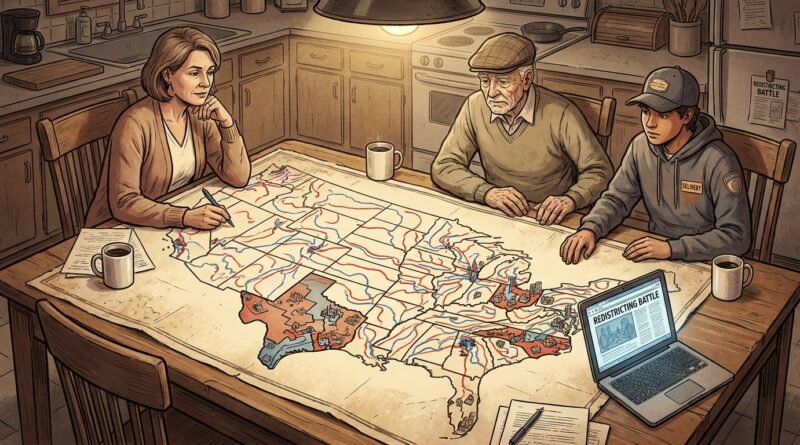
Trump’s New Congressional Map Shock: How a Quiet Redistricting War Could Tilt Power for a Decade
You are not imagining the confusion. One week you hear about a court ruling. The next week a state releases a new map. Then someone on TV says your district could flip Congress, even if nobody in your town moved. That is frustrating, and for a lot of voters it feels like the rules are changing in the background while regular people are busy living their lives. The fight over new congressional redistricting maps 2026 and what they mean for my vote is really about power. Who gets grouped together. Who gets split apart. And whether your neighborhood still has enough voting strength to matter. The big shock is not just one map tied to Trump-era political strategy. It is the quiet chain reaction. State lawmakers, governors, and courts are all making moves now that could shape House control for years. If you know what to look for, you can tell whether your community just got stronger, weaker, or pushed to the side before the next ballot is even printed.
⚡ In a Hurry? Key Takeaways
- New district maps can change who is likely to win Congress even before voters cast a ballot, because the lines decide which communities vote together.
- Check your district now, watch court deadlines, and learn the warning signs of “packing” and “cracking” before filing and registration cutoffs pass.
- This is not just political inside baseball. These maps can affect local voice, federal funding priorities, and whether your area has a realistic chance to elect someone who reflects it.
Why this fight matters more than it sounds
Redistricting sounds boring until it lands on your street.
Every 10 years, states redraw congressional districts. That part is normal. What is not normal is how often maps are now getting challenged, rewritten, blocked, or revived by courts right before major elections. That creates a rolling battle, not a one-time event.
When people talk about a “Trump map shock,” they usually mean a bigger Republican push to lock in House seats through favorable district lines, often using state control, legal timing, and turnout math. Democrats do this in states they control too. But because Republicans have had strong state-level power in many places, the effect can be especially large in the fight for Congress.
What a new map actually changes for your vote
Your single vote still counts. But the map helps decide how much your community can act together.
If your area gets “cracked”
Cracking means one community gets split into several districts. Picture one city neighborhood divided three ways, each attached to larger suburban or rural areas. That neighborhood still votes, but its voice gets watered down in every district.
If your area gets “packed”
Packing means a group of similar voters gets squeezed into one district more than needed. They may win that seat by a huge margin, but their influence in nearby districts disappears.
If your district just got unfamiliar
This is the part voters notice first. Your representative may change. Your polling place might stay the same, but your race could look totally different. A community that used to be competitive might become safely Republican or safely Democratic overnight.
Why 2026 is such a big deal
The timing is everything. Court fights over maps are happening close to the midterm season, when control of the House can swing on only a handful of districts. A map that changes two or three seats in one state can matter a lot if the national margin is thin.
And once a map survives legal review or simply stays in place long enough, it can shape elections for years. That means the real fight is often not election night. It is the quieter period before candidate filing deadlines, before local media catches up, and before voters realize they are in a new district.
The plain-English version of the legal battle
Most redistricting lawsuits come down to a few questions.
Was the map drawn to unfairly help one party?
This is called partisan gerrymandering. Courts do not always step in here, especially at the federal level. That is one reason map fights can feel so maddening. A map can look unfair to regular people and still survive.
Did the map weaken the voting power of racial or language minorities?
This often brings in the Voting Rights Act. These cases can have real teeth, and courts sometimes order states to redraw districts if minority communities were improperly split or submerged.
Did the state follow its own rules?
Some state constitutions ban favoritism, require compact districts, or say maps should respect city and county lines. State courts can become the biggest players in these fights.
How to tell if your community lost clout
You do not need a law degree or mapping software. Start with a few simple checks.
1. Compare your old district to your new one
Look at who got added and who got removed. If your area used to be grouped with nearby neighborhoods that share schools, transit, and local issues, but now gets tied to far-away places with little in common, that is a red flag.
2. Look at past election margins
If your old district was usually close, but your new district heavily favors one party, the map may have changed the race more than the voters did.
3. Ask whether your community was split up
Count how many congressional districts now cover your city, county, or neighborhood. More slices can mean less influence.
4. Watch for strange shape alone, but do not stop there
A weird-looking district can signal trouble, but shape is not the whole story. Some oddly shaped districts follow real population patterns or legal requirements. The key question is practical. Does the map keep your community together or break it apart?
What this means in real life, not just on cable news
If your district changes, several things can follow fast.
You may get a different member of Congress with different priorities.
Your area may become less competitive, which can reduce campaign attention and make general elections feel decided in advance.
Local issues, like flood control, transit, farm policy, housing, or military base jobs, may lose priority if your community is now only a small piece of a larger district.
And if your preferred candidate no longer lives in your district or decides not to run in a tougher seat, your choices can narrow before voting even starts.
What you should do right now
This is the useful part. Do not wait for a campaign ad to explain it.
Check your current district
Use your state election site or your county board of elections. Search your address, not just your ZIP code.
Check again after major court rulings
Maps can change late. Save the official elections page for your state and revisit it.
Watch candidate filing deadlines
If a new map changes who is running where, those deadlines matter. A district can look open one week and suddenly have a strong incumbent in it the next.
Update your registration if needed
Even if your home did not move, district changes can create confusion. Make sure your registration, party status where relevant, and polling information are current.
Show up at map hearings or submit comments
People often assume this part is fake participation. Sometimes it is not. Public pressure can affect final lines, especially in states with commissions or ongoing litigation.
Use plain language when speaking up
You do not need to say “malapportionment” or quote case law. Say this instead: “Our neighborhood shares schools, roads, and flooding issues, and this map splits us into three districts.” That is clear and hard to ignore.
What not to fall for
First, do not assume every new map is illegal. Some changes are routine.
Second, do not assume your vote no longer matters. Even in tilted districts, turnout, special elections, retirements, scandals, and court rulings can scramble expectations.
Third, do not wait for national media to tell you whether your community was affected. By the time a district becomes a national storyline, local deadlines may already be gone.
So, could this really tilt power for a decade?
Yes, it could.
House control is often decided by a narrow band of districts. Change enough of those through redistricting, and you do not just influence one cycle. You shape who gets committee chairs, what bills reach the floor, what investigations happen, and how federal money and attention get directed.
That is why these map fights feel so intense. They are not just about lines on paper. They are about whose voice gets amplified and whose gets muffled.
At a Glance: Comparison
| Feature/Aspect | Details | Verdict |
|---|---|---|
| Cracking | A community is split across several districts, which weakens its shared voting strength. | Bad for local voice if your neighborhood gets divided. |
| Packing | A group of similar voters is concentrated into one district, creating a big win there but less influence nearby. | Can protect one seat while weakening broader influence. |
| Late court changes | Judges may block, revise, or allow maps close to filing or voting deadlines. | Important to track now because timing can decide real-world impact. |
Conclusion
If all of this has felt confusing, that is because it often is confusing by design. But the core idea is simple. New district lines can change political power long before Election Day, and the latest redistricting moves and court rulings are landing right before midterm season, when a few seats can decide who runs Congress. The good news is that you do not have to be an expert to protect your community’s voice. Check your district, learn the signs of cracking and packing, watch the court calendar, and pay attention before filing deadlines and registration cutoffs quietly pass. That is how regular voters spot what is happening while there is still time to respond. And that matters, because once a map settles in, its effects can last long after the headlines fade.