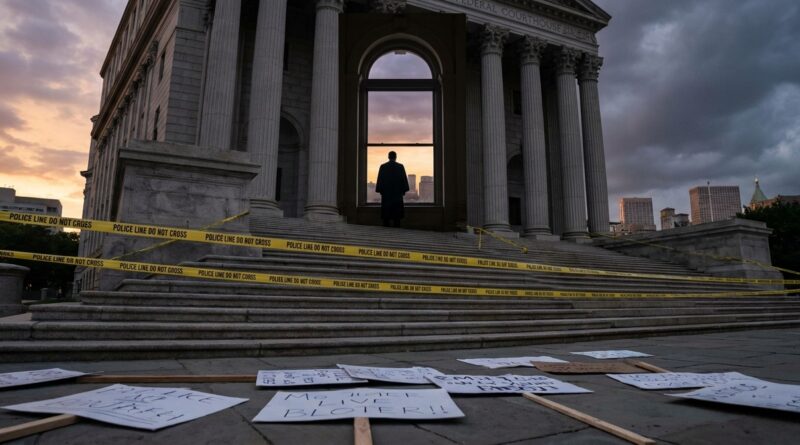
U.S. Judges Are Getting Death Threats. What Rising Court Intimidation Really Means For Your Rights
It is hard not to feel uneasy watching story after story about threats against judges, angry crowds outside courthouses, and politicians treating court rulings like personal insults. A lot of people are asking the same plain question. If the referees are being harassed, can regular people still trust the game? That worry is not overblown. When threats against judges and U.S. court independence become part of daily news, the damage does not stop with famous cases at the Supreme Court. It reaches divorce hearings, criminal trials, election disputes, school fights, workplace claims, and the basic promise that the law should apply the same way whether you are powerful or not. The good news is that intimidation does not automatically mean the system has collapsed. But it does mean the courts are under a real stress test, and the public needs to understand what is happening before “normal” gets quietly rewritten.
⚡ In a Hurry? Key Takeaways
- Threats and political attacks on judges are not just ugly side stories. They can weaken fair trials, independent rulings, and public trust in equal justice.
- Push back on casual “judge hunting” talk in your community. Criticizing decisions is fair. Threats, doxxing, and pressure campaigns aimed at fear are not.
- If court independence slips, ordinary people usually feel it first, through slower cases, more fearful judges, and weaker protection of basic rights.
Why this matters to people far from Washington
Most of us do not spend our mornings thinking about federal judges. We think about rent, school, work, traffic, health insurance, and whether our kids are safe. But courts sit underneath almost all of that.
They decide who gets protected from abuse, whether police followed the law, whether employers broke the rules, whether states can restrict voting, and whether agencies can enforce consumer protections. So when judges become targets, this is not some elite club drama. It lands in daily life.
Think of a judge like the person running a youth sports game. Fans can complain about bad calls. They can even boo. But if people start threatening the ref at home, publishing the ref’s address, and trying to scare them into making the “right” call next time, you no longer have a real game. You have pressure replacing rules.
What is actually happening
The pattern has grown more visible in recent years. Judges at different levels of the system have faced threats after election rulings, abortion decisions, criminal cases involving public figures, immigration disputes, and culture-war lawsuits. Some have had their homes protested. Some have had personal information spread online. Some have needed round-the-clock security.
The problem is bigger than one party or one case, though the intensity can spike around major national fights. Once public figures start talking as if judges are enemies to be punished instead of public officials whose rulings can be appealed, the temperature rises fast.
That matters because courts depend on something fragile. Not popularity. Legitimacy. Judges do not command armies. They rely on the public, lawyers, police, elected officials, and losing parties accepting that rulings count even when they sting.
Criticism is normal. Intimidation is different.
This is the line people need to keep clear. A judge can be criticized. A ruling can be blasted. A legal theory can be mocked. That is part of open debate.
But there is a real difference between saying, “This decision is wrong,” and saying, “This judge should be afraid.” There is a difference between lawful protest and making someone worry that their spouse, kids, or home are now part of the dispute.
Once fear enters the picture, the goal changes. It is no longer persuasion. It is control.
How intimidation changes the justice system
Most judges will tell you they are trained to ignore noise. Many do. But they are still human beings. And even if a threat never changes a final ruling, it can still distort the system in quieter ways.
Security starts crowding out access
Courthouses may tighten entry. Judges may limit public appearances. Hearings may become harder for ordinary people and local reporters to attend. Transparency suffers.
Recruitment gets harder
Good lawyers may decide the bench is no longer worth the risk. That is especially true for lower-profile state and local judgeships, where security resources are often thinner.
Judges may self-protect in subtle ways
Not necessarily by changing votes outright, but by writing narrower opinions, avoiding public explanations, or stepping back from controversial assignments when possible. Fear does not have to win loudly to do harm.
The public starts seeing courts as just another political cage match
That may be the biggest danger of all. If people stop believing judges can act independently, then every ruling looks bought, bullied, or rigged. When that happens, the side that loses does not think, “I lost under the law.” It thinks, “The other team had more pressure.”
Why regular people should care about court independence
Because “court independence” can sound abstract until you picture what it protects.
If your landlord ignores housing rules, you need a judge who is free to enforce them. If your child’s school violates a disability right, you need a judge who is not scanning the horizon for threats. If prosecutors overreach, if a state agency abuses power, if your employer discriminates, if a local board ignores the Constitution, the court is often the last stop.
That is why threats against judges and U.S. court independence in 2026 should not be treated as background noise. The courts are where rights become real, or fail to.
What makes this moment different
America has always had bitter fights over courts. That part is not new. What feels different now is the mix.
First, political language is hotter and more personal. Second, social media can turn a legal disagreement into a mob in hours. Third, personal details can be spread widely and cheaply. Fourth, many people already distrust institutions, so attacks on judges land on fertile ground.
In older eras, a citizen might grumble about a ruling at the diner. Now a furious post can become a pile-on, and a pile-on can become real-world harassment. The distance between outrage and danger is shorter.
What this does not mean
It does not mean every judge is above criticism. Judges can be biased, careless, ideological, or flat-out wrong. Courts sometimes deserve hard scrutiny. Ethics questions are real. Transparency matters. Appeals matter.
Defending judicial independence is not the same as pretending judges are perfect. It means insisting that legal errors be answered with legal tools. Appeal. Oversight. Ethics rules. Elections where judges are elected. Confirmation battles where judges are appointed. Investigations when warranted.
Not threats. Not stalking. Not turning homes into pressure points.
How to talk about this without sounding partisan
This is where a lot of people freeze up. They think the minute they defend judges, they will be mistaken for defending every ruling. You do not have to do that.
A simple way to say it
Try this: “I can disagree with a judge and still think threatening them is wrong. If judges are scared into decisions, nobody’s rights are safe.”
That is clear, fair, and hard to honestly argue with.
Keep the focus on process
Process sounds boring until it is the only thing standing between you and arbitrary power. The point is not that courts always get it right. The point is that they need room to decide without fear.
Use local examples
People understand this better when you bring it home. Family court. Criminal sentencing. School board lawsuits. Election certification. Property disputes. Suddenly it is not a cable news argument. It is about whether the local system still feels trustworthy.
What communities and officials can do
You do not need to be a senator to help lower the temperature.
Local leaders can draw a bright line
Mayors, sheriffs, county executives, bar associations, and state legislators can say plainly that criticism is legitimate but threats are criminal and corrosive. Silence can look like permission.
Media and influencers can stop feeding the mob
There is a difference between reporting on a judge and whipping up a target list. Publishing context is journalism. Posting addresses or nudging followers toward someone’s home is something else.
Neighbors can refuse to normalize it
This may sound small, but it matters. When someone jokes about judges being “dealt with” or shrugs at harassment because they like the outcome, say so. Normalization is how standards rot.
Three questions to ask when you see the next headline
1. Is this criticism, or is it intimidation?
Look for the method. Debate and protest are one thing. Threats, doxxing, and physical targeting are another.
2. Who benefits if courts look weak?
Often the answer is whoever wants power without review. Independent courts annoy everyone at some point. That is part of the job.
3. Would I accept this if the judge ruled my way?
This is the gut check. If intimidation only bothers you when it helps the other side, you are not defending principle. You are defending your team.
At a Glance: Comparison
| Feature/Aspect | Details | Verdict |
|---|---|---|
| Public criticism of judges | Protected speech, legal debate, protests, and strong disagreement with rulings | Healthy in a democracy, as long as it stays lawful and non-threatening |
| Threats and personal targeting | Death threats, doxxing, home harassment, or efforts meant to create fear | Dangerous to judges, corrosive to fair rulings, and harmful to everyone’s rights |
| Court independence | Judges making decisions based on law and facts, not partisan pressure or personal safety concerns | Essential if ordinary people want equal treatment and real protection under the law |
Conclusion
The rise in threats and political attacks on judges is not just inside baseball for legal nerds and cable news panels. It is a direct test of whether ordinary people can still count on fair trials, independent rulings, and basic rights being enforced when it matters most. If judges are pushed to rule with one eye on the law and one eye on their front porch, everybody loses. The useful takeaway is simple. You do not have to love every court decision to defend the courts themselves. Understanding this moment gives you a clearer way to talk about it with neighbors, push back when local officials join the pile-on, and protect an institution that quietly shapes daily life more than most of us realize. The rules still matter, but only if we insist the referees are allowed to do their job without fear.