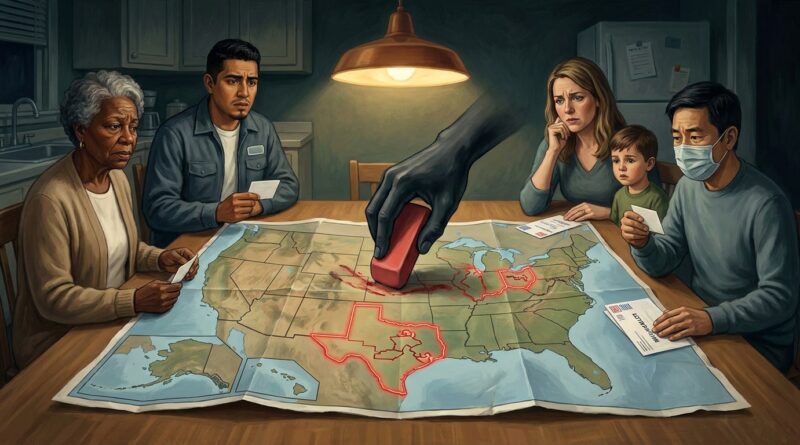
Supreme Court’s New Voting Map Ruling: How Your Community’s Voice Just Got Weaker Overnight
If you already feel like your vote gets watered down long before Election Day, you are not imagining it. The Supreme Court’s new ruling tied to Louisiana redistricting makes that fear more real for a lot of communities. In plain English, the Court made it harder to use race as a reason to challenge voting maps, even when race and politics are tangled together in obvious ways. That matters because map drawers do not need to say, “We are weakening Black or Latino voting power.” They can often say, “We are just drawing for politics,” and that may now be enough. The result is simple and grim. Safer seats for politicians. Less competition. Fewer districts where communities of color can actually choose someone who reflects their needs. This is not abstract court talk. It can change who gets heard in Congress, who gets ignored, and which neighborhoods lose clout for the next decade.
⚡ In a Hurry? Key Takeaways
- The Supreme Court’s latest move on Louisiana redistricting makes it easier for lawmakers to defend maps that weaken minority voting power by calling them “political,” not racial.
- If you live in a state facing map fights, check your district lines, contact local voting rights groups, and watch state court and legislative hearings now, not next fall.
- This ruling does not erase the Voting Rights Act overnight, but it weakens one of its most useful tools and could reshape House seats for years.
What actually happened
The case grows out of Louisiana, where courts had already found that the state likely needed a second majority-Black congressional district. Black residents make up about a third of the state, yet for years only one of six congressional districts gave Black voters a strong chance to elect their preferred candidate.
That fight looked, at first, like a fairly direct Voting Rights Act dispute. Section 2 of the Act says voting rules and maps cannot deny minority voters an equal opportunity to participate in the political process and elect representatives of their choice.
Now comes the harder part. The Supreme Court’s new ruling narrows how race can be considered when courts review these maps. The legal line the Court is drawing is this: if race and party are mixed together, lawmakers may get more room to say they acted for partisan reasons, not racial ones.
For regular voters, that sounds technical. But the practical effect is not. It gives map drawers a bigger shield.
Why this matters more than it sounds
Redistricting is one of those topics that makes people’s eyes glaze over right up until it affects something personal. School funding. Roads. Disaster aid. Which neighborhoods get listened to. Which ones get treated as afterthoughts.
When district lines are drawn in a way that cracks apart a community or packs it into one district, that community can lose real political power even if everyone still gets to cast a ballot. Your vote still exists. It just matters less in shaping who wins.
That is why this ruling stings. It weakens a part of the Voting Rights Act that has long been used to push back when minority communities were sliced up on a map and told it was perfectly neutral.
Why Louisiana is the big warning sign
It shows how the new rule may work in practice
Louisiana is not important only because the case started there. It matters because it is a preview of what could happen in other states where race and party strongly overlap.
In many Southern states, Black voters lean Democratic in high numbers. Latino voters in some states do too, though patterns vary. That means lawmakers can often describe a map choice as “partisan” even when the effect falls heavily on racial minorities.
That overlap has always made these cases hard. The Court just made them harder.
It could affect control of the House
One district here, one district there, and suddenly the balance of power in Congress shifts. This is why these rulings matter beyond one state. If courts become less willing to strike down maps that reduce minority voting strength, one party can lock in a structural edge without winning more voters statewide.
That is a big reason people are alarmed. This is not just about legal theory. It is about who gets a durable advantage baked into the map.
Who is most at risk
Black communities in the South are at the center of this problem, especially in states where their populations are large enough to support additional opportunity districts but are spread in ways that can be manipulated.
Latino communities may also face trouble, especially in fast-growing states where map drawers can split neighborhoods among several districts. That can make a rising community look politically smaller than it really is.
Multiracial metro areas are also vulnerable. On paper, they may seem diverse and represented. In reality, district lines can split shared economic and social interests into pieces small enough to be ignored.
What the Court did not do, and why that still matters
It is important to be careful here. The Court did not say race can never be considered. It did not erase Section 2 of the Voting Rights Act in one stroke. And it did not suddenly make every disputed map legal.
But this is one of those rulings where the fine print is the story. By making it easier to sort map decisions into the “politics, not race” bucket, the Court weakened a key path that civil rights groups have used for decades.
If you are thinking, “That sounds like a loophole big enough to drive a campaign bus through,” yes. That is the concern.
What this means for your community
If you live in a heavily Black or Latino area
Your community may find it harder to challenge maps that divide your voting power. Even if the effect is obvious on the ground, proving that race was the deciding factor may now be tougher.
If you live in a competitive state
You may see map fights become even more aggressive. Politicians already know district lines can be as powerful as campaign ads. This ruling gives them more confidence to push right up to the edge.
If you think your district already looks weird
Trust your instincts. Odd shapes are not always illegal, but when a map seems designed to split neighborhoods with shared interests, there is usually a reason. Sometimes that reason is to weaken the voters most likely to challenge the people in power.
What ordinary voters can still do
This is the part people often skip because it feels smaller than a Supreme Court ruling. It is not small.
1. Look up your current district and proposed maps
Do not assume someone else is watching. State legislatures and redistricting commissions often move this process along quietly. Check your secretary of state website, state legislature site, or local election board.
2. Follow local voting rights groups
Groups on the ground are usually first to spot when a map splits neighborhoods, dilutes minority votes, or protects incumbents. They also tell you when hearings happen and where public comments can still matter.
3. Show up before the map is final
Once lines are locked in, fixing them is slow and expensive. Public hearings are boring, yes. They are also one of the last places ordinary people can get concerns into the record.
4. Pay attention to state courts, not just Washington
Some of the most important redistricting fights now happen in state court under state constitutions. In some places, state protections for fair elections are stronger than what federal courts currently allow.
5. Keep the pressure on between election cycles
Redistricting news fades fast. Politicians know that. The people who benefit from weak maps are counting on you to tune out until the next big election. That is exactly when the most important map decisions get made.
Why people are calling this a voting rights setback
Because it is one. Not in a loud, simple, headline-ready way. In a lawyerly way. In a “the rule is narrower now, and the burden is heavier now” way.
That kind of change can be even more powerful because it sounds procedural. It lets people say nothing dramatic happened. Meanwhile, communities that once had a decent shot at electing a representative of their choice can find that shot shrinking year by year.
This is how representation gets weakened without anyone taking away the ballot itself.
At a Glance: Comparison
| Feature/Aspect | Details | Verdict |
|---|---|---|
| Voting Rights Act protection | Section 2 still exists, but it is harder to use when lawmakers argue maps were drawn for party advantage rather than race. | Weaker than before |
| Impact on communities of color | Black and Latino voters may have a harder time challenging maps that split or pack their communities. | Higher risk of diluted representation |
| Political fallout | Safer seats and less competitive districts could help one party keep a House edge for multiple election cycles. | Potentially major |
Conclusion
If this ruling left you feeling like the game just got a little more rigged, that reaction makes sense. The Supreme Court’s move on Louisiana redistricting weakens a core voting rights safeguard at a moment when control of Congress can turn on just a handful of districts. The point is not only who won a legal fight in Washington. It is how power shifts on actual maps, in actual neighborhoods, often before most people know a fight is happening. The good news, if there is any, is that map battles are not over. State courts, local pressure, public records, and organized voters still matter. A lot. The key now is to pay attention before the next round of maps is quietly locked in. Once the lines are set, communities can spend years living with the consequences.