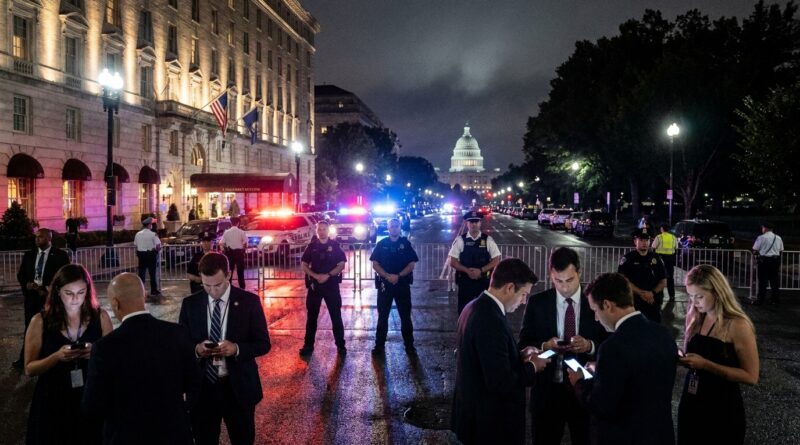
Trump Evacuated From Correspondents’ Dinner: What a Political Shooting Scare Reveals About America’s Security Theater
You probably saw the alerts, the half-formed reports, the frantic social posts. “Shots fired.” “Trump evacuated.” “White House Correspondents’ Dinner chaos.” Then, just as fast, the story got swallowed by pundit talk and partisan noise. That is frustrating for regular people, because the question is not just what happened in one tense moment. It is what happens next. When there is a reported threat around a president or former president, security agencies move fast, information gets messy, and the public is often left with a mix of fear and fog. The important part is this. A high-profile scare in Washington can shape how police respond, how events get secured, how protest zones are set up, and how emergency powers are justified later. So if you are trying to figure out whether the Trump evacuated from White House Correspondents Dinner shooting scare changes anything beyond the ballroom, the answer is yes. Not always in obvious ways, but often in ways worth watching.
⚡ In a Hurry? Key Takeaways
- High-profile shooting scares near protected officials rarely stay limited to one incident. They often lead to tighter security rules, wider police perimeters, and faster use of emergency authority.
- Watch what changes locally after the headlines fade, including road closures, protest restrictions, surveillance tools, and “temporary” security measures that stick around.
- Your safety matters, but so do civil liberties. The smart move is to track both the threat response and whether officials clearly explain why new restrictions are needed.
What actually matters in a scare like this
When reports say a president was rushed out or protected after possible gunfire nearby, most people focus on the drama. That is natural. But the bigger story is usually the machinery that starts turning in the background.
The Secret Service, local police, federal investigators, and event security do not just react to one sound or one suspect. They treat uncertainty itself as a risk. If there is even a chance that a protectee is in danger, they lock things down first and sort details out later.
From a safety standpoint, that makes sense. From a public accountability standpoint, it gets tricky fast.
Why the details are often confusing at first
In the first hour of any security scare, the public picture is usually messy. Witnesses mishear sounds. Reporters race to confirm scraps of information. Officials release little, because they are trying not to compromise an active response.
That means early stories can mix together several different things. A suspected shooting. A lockdown. A precautionary evacuation. A nearby arrest. These are not all the same event, even if they arrive in your phone as one blur of alerts.
So if you were left wondering what the Trump evacuated from White House Correspondents Dinner shooting reports really meant, you are not alone. The first public version of events in moments like this is almost never the clean final version.
How federal protection rules change the response
Protected people get a different level of caution
Once a current or former president is involved, normal event security becomes presidential security. That changes everything. Streets can close with little warning. Guests can be held in place. Nearby people can be stopped, searched, or moved quickly.
The standard is not “wait until danger is proven.” The standard is “act before danger reaches the protectee.”
The public often sees the outer ring, not the full operation
You may notice officers redirecting traffic, blocking sidewalks, or pushing press and guests farther back. What you do not see is the layered setup behind that. Counter-sniper positions, route changes, hardened motorcade paths, building sweeps, communications lockdowns.
That is why a brief scare can produce an outsized response. It is not theater in the sense of being fake. It is theater in the sense that visible force and control are part of the system.
What “security theater” really means here
Security theater does not mean there is no real threat. It means some visible security steps are designed as much to signal control as to reduce risk in a measurable way.
Think of it like airport security after a scare. Some steps help a lot. Some help a little. Some mainly reassure people or show that officials are “doing something.” In political Washington, those lines blur all the time.
After a shooting scare, you may see more barricades, wider no-go areas, tighter screening, more aggressive credential checks, and heavier police presence. Some of that is reasonable. Some may last longer than the facts justify.
Why this connects to domestic terror fears
The reason officials react so strongly is not just the identity of one public figure. It is the larger threat picture. Federal agencies have spent years warning about lone actors, extremist violence, copycat attacks, and people radicalized online.
That changes the math. If authorities think a chaotic incident could be part of a wider pattern, they will often build policy around worst-case scenarios.
For the public, that means one failed or unclear attack can still become the argument for broader restrictions later.
What tends to change after a high-profile threat
1. Event access gets tighter
Expect more checkpoints, stricter guest lists, shorter standoff distances, and heavier screening at political and media events.
2. Protest space can shrink
Officials may expand buffer zones around venues and officials. Sometimes that is for safety. Sometimes it also pushes dissent farther from cameras and public view.
3. Surveillance can grow quietly
More cameras. More license plate readers. More phone-based geofencing requests. More coordination between local and federal systems.
4. “Temporary” powers can linger
Emergency traffic rules, crowd-control protocols, and restricted access policies have a habit of sticking around after the original threat is gone.
How to tell reasonable security from opportunistic overreach
This is the part most people miss. After a scary incident, ask not only “Is this keeping people safe?” Ask “Is this narrow, explained, and time-limited?”
That three-part test helps a lot.
Narrow
Does the response match the specific threat, or is it sweeping in unrelated activity?
Explained
Have officials said what changed, why it changed, and when it will be reviewed?
Time-limited
Is there a clear end date, or are emergency rules being treated like the new normal?
If the answer is no on all three, you may be looking at a policy move that uses fear as cover.
What people in ordinary cities and towns should watch for
You do not need to live near the White House to feel the ripple effects of incidents like this. Local governments often copy federal security logic, especially after national headlines.
Watch city council agendas, police budget requests, temporary event rules, and permit changes. Pay attention when officials propose new barriers, camera systems, drone policies, or expanded exclusion zones around public gatherings.
The pattern is usually quiet. A dramatic event happens somewhere else. A local policy appears months later. It gets sold as common sense. Few people connect the dots.
What not to do when the alerts start flying
Do not assume the first viral explanation is right. Do not share claims that rely on one unnamed source and a dramatic screenshot. And do not treat every visible security move as proof of either tyranny or total safety.
Early information is often incomplete. Public fear fills the gap. That is exactly when bad takes spread fastest.
A practical checklist for the next big scare
When another major incident breaks, use this simple filter.
Check the source chain
Is the report coming from law enforcement, a pool reporter, a verified outlet on scene, or just reposted rumor?
Separate the threat from the response
A “shot fired” report and a “president evacuated” report are connected, but they are not identical facts.
Look for the second-day changes
The most important story is often what gets added after the panic. New security rules. New restricted areas. New surveillance spending.
Ask who absorbs the burden
Protected officials usually get more insulation. Everyone else gets the inconvenience, the scrutiny, and sometimes the reduced freedom of movement.
Why power is insulated differently than the public
This may be the hardest truth in the whole story. When elite political spaces face danger, the system reacts with speed and resources most ordinary communities never see.
If there is a threat near a presidential event, roads clear, teams mobilize, and decisions happen instantly. If there is a threat in a school, on a transit line, or in a neighborhood, response can be slower, patchier, and less coordinated.
That gap matters. It tells you that security in America is not just about danger. It is also about whose danger counts fastest.
At a Glance: Comparison
| Feature/Aspect | Details | Verdict |
|---|---|---|
| Immediate evacuation response | Fast, aggressive, and built around uncertainty when a protected official may be at risk. | Usually justified in the moment. |
| Expanded security measures | Barricades, screening, closures, protest limits, and added surveillance can follow even if facts remain murky. | Needs public scrutiny. |
| Long-term public impact | The biggest effect is often not that night’s chaos, but the quiet policy changes that come after. | Most important thing to watch. |
Conclusion
The attempted attack in Washington on April 24 is about much more than one chaotic night in a hotel ballroom. It is a reminder that when fear hits elite political spaces, security systems move fast, visibility drops, and new restrictions can follow before the public has a clear account of what happened. The useful takeaway is not to panic. It is to pay attention. Watch for changes in access, protest rules, surveillance, and emergency powers in the days and weeks after the headlines move on. That is how you protect both safety and civil liberties at the same time. If you understand that pattern now, you will be in a much better position to spot the next moment when a real threat becomes a reason for broader control.