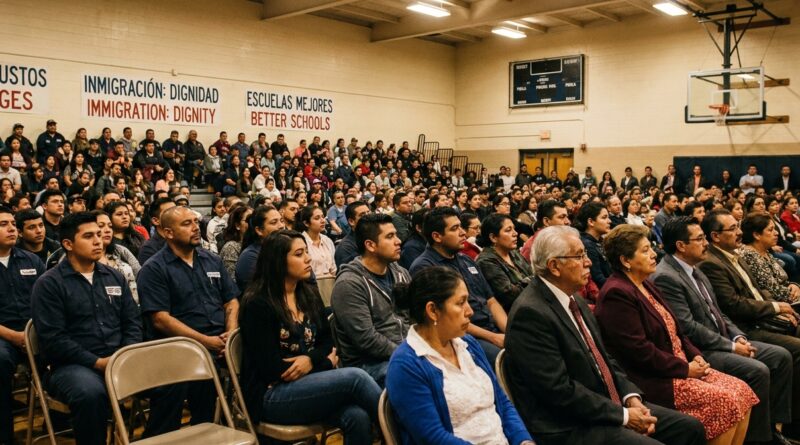
Poll Shock: Latino Voters Are Turning Away From Trump. Here’s What That Really Means For 2026
If you are tired of hearing politicians suddenly talk about Latino voters like a prize to be won, you are not alone. Every election cycle, both parties roll out fresh polls, fresh promises and the same old claim that they finally understand your community. It can feel noisy and a little insulting. Especially when what people actually want is pretty simple. Better pay. Safer streets. Good schools. A sane immigration system. Respect that lasts longer than campaign season. The latest numbers suggesting Latino voters are turning away from Trump and, in some places, cooling on the GOP matter because they could shake up the 2026 midterms in a real way. But one poll is not a revolution. It is a signal. The useful question is not “Who won the poll?” It is “What changes now?” That is where this gets interesting, and where Latino communities may have more political power than the headlines are letting on.
⚡ In a Hurry? Key Takeaways
- A new polling slide for Trump and the GOP among Latino voters could reshape key House and Senate races in 2026, but it does not mean Latino voters are moving as one bloc.
- Watch local races, turnout work, and issue-specific promises on jobs, schools, immigration and policing. That is where this trend turns into real power.
- Polls are snapshots, not guarantees. Communities get the most value when they push candidates for specific commitments, not slogans.
What the poll is really saying
When people search for “Latino voters turning away from Trump poll 2026 midterms,” they usually want a clean answer. Here it is. If the numbers hold, Republicans could lose some of the gains they made with Latino voters in recent cycles, and Democrats could get a second chance in districts they thought were slipping away.
That matters because Latino voters are not tucked into one neat corner of the map. They are central to politics in Arizona, Nevada, Texas and Florida. They also matter in Colorado, California, New Jersey, Illinois and parts of the Midwest where suburban and working-class voters can swing close races.
Still, this is where cable news often gets lazy. “Latino voters” is not one single political identity. Cuban voters in Florida, Mexican American families in South Texas, Puerto Rican communities in Pennsylvania, and younger Latino renters in Phoenix do not all react to the same message the same way. A shift in national polling can be real without being uniform.
Why some Latino voters may be pulling back from Trump
There is rarely one reason. Usually it is a mix.
Immigration rhetoric still hits hard
Even Latino voters who care deeply about border security can recoil from language that sounds sweeping, harsh or dehumanizing. Many households include mixed immigration stories. Citizens, green-card holders, undocumented relatives, military service, small business ownership. It is personal, not abstract.
Economic frustration cuts both ways
Republicans made gains by talking about inflation, work and cultural frustration. That message landed with some Latino men and working-class families. But if costs stay high, wages feel stuck, or promises sound recycled, support can soften fast. Voters often punish whoever sounds loudest if life still feels expensive.
Local issues are stronger than national branding
In many communities, school quality, housing costs, neighborhood safety and healthcare access beat party identity. If Republicans are seen as all message and no neighborhood results, they can lose ground. The same is true for Democrats, by the way.
What this could mean for the 2026 midterms
This is the part that actually matters. Not the drama. The map.
Border districts could get more competitive
Some South Texas and Arizona districts that looked friendlier to Republicans could tighten if Latino support slips even modestly. In close races, a few points is not a footnote. It is the whole story.
Midwest and Sun Belt suburbs could shift
Latino voters are growing in suburban areas that decide House races. If Democrats recover support there, they may become more competitive in districts that looked out of reach a year ago. If Republicans hold even part of their recent gains, they can still keep those seats in play.
State-level races may get scrambled too
Governors, Senate candidates and even school board campaigns pay attention to these trend lines. Why? Because voter movement at the national level changes where money goes, where ads run and where candidates suddenly start showing up for town halls.
What both parties are likely to do next
Expect a lot of sudden interest in Latino communities. Some of it will be real. Some of it will be painfully obvious election-year theater.
Democrats will try to rebuild trust
They will likely stress abortion rights, public education, healthcare, labor issues and immigration reform. The risk for Democrats is talking like support is owed to them. It is not. If they sound entitled, they waste the opening.
Republicans will try to stop the bleeding
They will focus on cost of living, crime, entrepreneurship, religious values and border control. Their challenge is tone. A message about order and opportunity can work. A message that sounds contemptuous can erase it.
What readers should watch instead of campaign spin
This is where you can cut through the noise.
1. Look for specific promises, not “outreach”
If a candidate says they care about Latino families, ask what that means in plain English. More teachers? Lower housing costs? Faster work permits? Small business loans? Police accountability? Show the plan.
2. Watch field work, not just TV ads
A campaign that hires local organizers, shows up in Spanish and English, visits churches, union halls, schools and neighborhood groups is doing more than checking a diversity box. Ground work usually tells you who is serious.
3. Pay attention to turnout, not just preference polls
A party can “win” a poll and still lose an election if the people who agree with them do not vote. Registration drives, absentee ballot help and early-vote efforts matter a lot in Latino communities, especially among younger and first-time voters.
4. Notice which issues keep coming up at the kitchen table
The smartest read on politics is often local. What are people talking about after Mass, at the barber shop, at school pickup, at work? Rent? Overtime? Safety? Deportation fears? That is usually more useful than a flashy national ad.
Why this does not mean Latino voters are “coming home” to either party
That phrase gets used a lot, and it misses the point. Many Latino voters are not looking for a political home. They are shopping. They are comparing. They are willing to split tickets, skip races, switch sides or back an independent if the major parties seem fake.
That independence is exactly why this polling shift matters. It tells both parties that Latino voters are persuadable, not programmable. For communities that have long been talked at instead of listened to, that is a big deal.
The practical bottom line for 2026
If this trend continues, candidates in competitive districts will have to treat Latino neighborhoods less like photo-op territory and more like decision-making centers. That could affect what gets funded, what gets debated and who gets invited into policy talks on immigration, wages, policing and schools.
And if the trend fades? That is still useful information. It would mean frustration did not turn into a stable voting change. Either way, Latino voters are setting the pressure points for 2026 more than many national commentators want to admit.
At a Glance: Comparison
| Feature/Aspect | Details | Verdict |
|---|---|---|
| What the poll shows | A drop in Trump and GOP support among some Latino voters compared with prior strength. | Important signal, but not final proof of a lasting shift. |
| Who it affects most | Competitive House districts, border regions, Sun Belt suburbs and a handful of statewide races. | Could seriously change the 2026 map if turnout follows the polling. |
| What voters should do with it | Use the attention to demand specific commitments on local issues instead of settling for broad cultural messaging. | Best way to turn poll attention into real community results. |
Conclusion
This story matters because a real drop in Trump and GOP support among Latino voters could scramble the 2026 midterm map from border districts to Midwest suburbs. That does not mean one party has cracked the code. It means Latino communities may have a stronger voice right now than the usual horse-race coverage suggests. If readers keep their eye on which races get tighter, which policies suddenly move, and which candidates start speaking in specifics instead of clichés, they will have a clearer view than most of the morning headlines offer. The smart move is not to get swept up in the spin. It is to use this moment, ask harder questions and make both parties earn the right to be heard.