From Classroom to Culture War: How a Texas Bible Bill Could Quietly Rewrite Public Education Nationwide
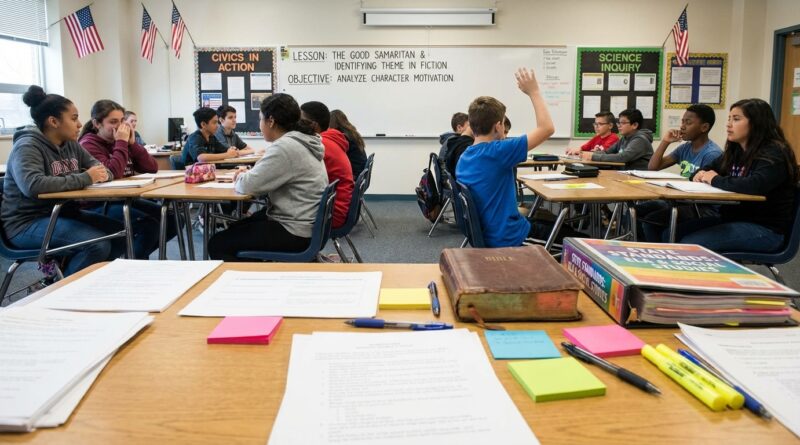
Parents are exhausted, and for good reason. One week the school debate is about phones, the next it is book bans, then suddenly it is the Bible. Most families do not have time to read bill text or sit through school board meetings, so they are left with slogans instead of facts. The Texas bill requiring Bible stories in public schools is a good example. Supporters frame it as a simple return to “traditional values.” Critics see a First Amendment problem. Both sides are loud. What often gets missed is the practical question parents actually care about. What would change in a real classroom on a normal Tuesday morning? The short answer is this. A bill like this would not stay neatly inside Texas. If it passes and survives court fights, it becomes a model. Other states copy the wording, school districts adjust lesson plans, publishers change materials, and a “local” debate starts shaping public education far beyond one state line.
⚡ In a Hurry? Key Takeaways
- The Texas bill requiring Bible stories in public schools could change curriculum rules well beyond Texas if other states copy it.
- Parents should ask now, in writing, whether their district plans to change reading lists, teacher guidance, or opt-out policies.
- This is not just a political food fight. It can affect what children are taught, how teachers teach, and whether schools stay neutral on religion.
What the Texas proposal is really about
At its core, this is a fight over what public schools are for.
There is a big difference between teaching about religion and requiring religious material in a way that feels devotional. Public schools have long been allowed to teach the Bible in a limited academic context. For example, a literature or history class can discuss biblical references, the role of religion in American history, or how Bible stories influenced art and language.
The legal and cultural fight begins when that line starts to blur. If a state pushes schools to require Bible stories as a regular part of instruction, the key questions become very simple.
- Is the material being taught for academic understanding, or as moral guidance?
- Do families have a real opt-out?
- Are other faiths treated fairly?
- Are teachers being asked to act like religious instructors?
Those details matter more than the political sales pitch.
What this could look like in your kid’s classroom
It may not arrive as a dramatic change
This is one reason parents often miss it. The shift may come quietly.
A district might not announce, “We are turning class into Bible study.” Instead, it may show up in smaller changes.
- New reading passages based on Bible stories in elementary materials
- State-approved lesson plans that treat biblical stories as moral instruction
- Teacher training that nudges staff toward one religious framing
- Tests that assume students know specific Christian stories
- Reduced room for teachers who want a more neutral approach
For many families, the first sign is not a public debate. It is homework.
Teachers could be put in a no-win situation
Teachers are usually the people asked to carry out these policies, even when the rules are vague. That creates a mess fast.
If a teacher presents Bible stories too neutrally, some activists may say they are undermining the law’s purpose. If they present them too devotionally, other parents may say the school crossed a constitutional line. That leaves teachers trying to guess where the boundary is, with their jobs in the middle.
Students from minority faiths, or no faith, feel it first
This is where “local values” talk can hide the real impact. A classroom is not made up of one kind of family. It includes Christian kids, Jewish kids, Muslim kids, Hindu kids, atheist kids, and children whose parents simply do not want the state guiding their religious life.
When one tradition gets special status in a public school, those students notice. They always do.
Why this is bigger than Texas
State education fights spread the same way software updates do. One place tests it. If it works, it rolls out wider.
Copycat bills are common
Lawmakers borrow from each other all the time. If a Texas measure gets traction, similar bills can appear in Oklahoma, Florida, Tennessee, or elsewhere with only minor edits. Sometimes they are introduced by legislators using shared model language from advocacy groups.
That is why the Texas bill requiring Bible stories in public schools matters nationally. Even families nowhere near Texas should pay attention.
Publishers and curriculum companies follow big states
Texas has outsized influence because of its huge school market. When a large state changes curriculum expectations, publishers pay attention. They may create materials that fit the new rules, then sell those materials widely because it is cheaper than making 50 different versions.
That means one state’s culture war can end up sitting on desks in many others.
Court rulings can reset the boundaries
If a law like this is challenged, judges may end up deciding how far a state can go in steering religious content in public schools. A ruling in one case does not instantly rewrite every classroom in America, but it can give lawmakers elsewhere a roadmap.
That is the quiet part. These fights are often presented as noisy local politics, but they are also legal test cases.
The plain-English constitutional issue
You do not need a law degree to understand the basic concern.
Public schools are government institutions. The government has to be very careful about promoting religion. It cannot favor one faith in a way that pressures families or students. It also cannot treat religion as off-limits in every academic setting. That is why the line is tricky.
The safe zone is teaching religion as part of history, literature, or culture. The danger zone is state-backed religious instruction dressed up as curriculum.
If a bill requires Bible stories in a way that gives Christianity a preferred place in public school instruction, courts will almost certainly be asked whether the state crossed that line.
How supporters are selling it, and what to watch for
Supporters usually make a few familiar arguments.
- The Bible is historically important
- Students need cultural literacy
- Schools should reflect community values
- This is about education, not religion
Some of those claims are partly true. The Bible is historically important. It does show up in literature, art, and politics. The issue is not whether students can ever learn about it. The issue is whether the state is requiring one sacred text in a way that goes beyond neutral education.
So when you hear the sales pitch, ask these questions.
- Who wrote the lesson plans?
- Are other religious traditions included in a balanced way?
- Can parents opt out easily, without punishing the child?
- Will this appear on graded assignments or tests?
- What guidance has been given to teachers?
What parents can do before the next school year
Ask for the actual policy, not a summary
Do not settle for social media posts or political flyers. Ask your district for the proposed curriculum language, board agenda items, and any teacher guidance documents.
Check whether “required reading” really means required
That phrase can hide a lot. Does it mean a story appears in a broader literature unit? Does it mean daily instruction? Does it mean students are tested on religious content? Details matter.
Ask about opt-out rules now
If your district says families can opt out, ask how. Is there a simple form? Will the child be given an equal alternative assignment? Will opting out single the student out in class?
Talk to teachers respectfully
Most teachers are not trying to start a culture war. They are trying to survive one. Ask what they have actually been told to do, and whether the district has given clear instructions.
Show up early, not after the vote
By the time a change is obvious in the classroom, the important decisions may already be locked in. School boards and state agencies often move these things forward months before families notice.
What this means for families who do support Bible instruction
Even if you like the idea, there is still a reason to want clear guardrails.
A vague law is bad for everyone. It can lead to sloppy teaching, lawsuits, angry board meetings, and confused students. If a district is going to include biblical material, families should still demand transparency, academic standards, and respect for religious freedom. That protects believers too.
At a Glance: Comparison
| Feature/Aspect | Details | Verdict |
|---|---|---|
| Classroom impact | Could change reading lists, lesson plans, testing, and teacher instructions, often in ways parents do not see until school starts. | Real and immediate if adopted. |
| National reach | Texas often acts as a model for publishers, advocacy groups, and lawmakers in other states. | Much bigger than a local Texas issue. |
| Legal risk | If the policy looks like state promotion of religion rather than neutral education, court challenges are likely. | High risk if the wording or classroom use goes too far. |
Conclusion
This is why families should not brush this off as just another noisy school fight in another state. Fights over what kids read are no longer just local drama. They are test runs for national policy. And ordinary parents are usually the last to hear the full story, often after the rule changes are already in place. The good news is that you do not need to become a full-time activist to protect your child’s learning environment. You just need to ask early, ask clearly, and insist on transparency. When a state starts pushing the Bible into public school curriculum, the question is not only whether that is legal. It is whether families are being told honestly what is changing, who it affects, and how far it could spread. Seeing that early is the best way to protect classrooms before next year’s culture war becomes everyday routine.