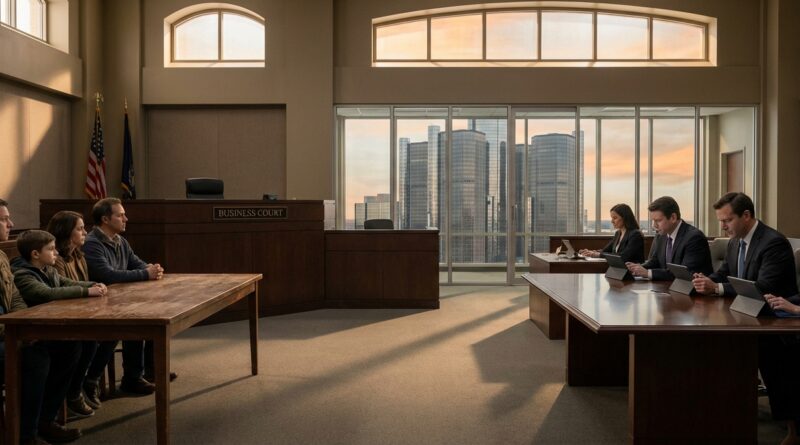
The Quiet Power Shift: How State Courts Are Quietly Rewriting the Rules for Big Business
It is easy to feel whiplash from national politics right now. One day it is protests. The next day it is foreign policy. Then another round of drama from Washington. If you are exhausted, you are not alone. But while most people are watching the loud fight on TV, a quieter change is moving through state capitals. It sounds dry. It is not. New state business courts and specialized appeals benches are being set up in ways that can make life easier for big companies and harder for workers, consumers, and small rivals. These changes often come wrapped in friendly language about efficiency, growth, and being “business friendly.” Sometimes that is partly true. But case by case, these courts can narrow where lawsuits are heard, who gets to hear them, and how fast corporate interests get answers. That affects jobs, prices, contracts, and your rights long before it becomes a national headline.
⚡ In a Hurry? Key Takeaways
- State business courts and corporate power are becoming more closely linked as states build judge-made fast lanes for complex business disputes.
- Ask your state lawmakers who appoints these judges, what kinds of cases they hear, and whether workers or consumers lose options when cases move there.
- This matters beyond legal circles. It can shape how easy it is to challenge a company over fraud, contracts, monopolistic behavior, or workplace harm.
The shift most people are missing
When a state says it wants to attract employers, that can sound harmless, even smart. Jobs matter. Investment matters. No one wants a sluggish court system.
But here is the catch. Some states are not just speeding up paperwork. They are changing the legal map itself. They are creating special courts or dockets for business disputes, often staffed by judges chosen in ways that look different from the normal local court process.
Supporters say this helps everyone because business cases can be technical and expensive. A judge who sees these disputes every day may move faster and make fewer mistakes.
Critics say that story leaves out the power imbalance. If a legal system is redesigned mainly around what large corporations want, regular people may find themselves with fewer paths to challenge bad conduct. The rules may not scream “corporate favoritism” on paper. But over time, they can still tilt the field.
What are state business courts, exactly?
Think of a normal court as a general family doctor. It sees all sorts of problems. A business court is more like a specialist. It handles a narrower set of disputes, usually big contract fights, shareholder claims, merger battles, trade secret disputes, and other cases involving companies.
That sounds reasonable enough. Specialization can be useful. We do it in medicine, engineering, and tax law.
The concern is not the idea alone. It is the design.
Why design matters
A few questions tell you almost everything you need to know:
- Who gets to choose the judges?
- What kinds of cases are allowed in?
- Can ordinary plaintiffs still use local courts and juries?
- Is there a special appeals path?
- Are the rules written to attract corporate filings from outside the state?
If the answer to those questions consistently favors speed, predictability, and convenience for large firms over access and flexibility for everyone else, you are looking at more than administrative reform. You are looking at a power shift.
Why Texas keeps coming up
Texas has become a major example because it has moved aggressively to market itself as a place where businesses can get a friendlier legal home. That includes new business court structures and a specialized appeals setup. The pitch is simple. If companies want certainty, efficiency, and judges focused on commercial law, Texas wants to be ready.
Again, that is not automatically sinister. States compete all the time. Delaware has done this for years with corporate law. Nevada and others have tried their own versions too.
What makes people uneasy is the broader pattern. If states start competing to make corporate litigation smoother while consumer and worker claims stay messy, slow, and expensive, the system can become two-tiered. One lane for capital. Another for everyone else.
The small print matters more than the sales pitch
Public messaging tends to focus on efficiency. What gets less attention is whether the new system changes leverage in settlement talks, reduces chances for jury trials, or channels key decisions to judges selected through a more top-down process.
That can shape outcomes even before a case reaches trial. Most disputes settle. So if one side believes the forum is better for them, that alone changes bargaining power.
How this affects people who will never set foot in a business court
This is the part that often gets lost. You do not need to be a CEO, investor, or lawyer for these changes to matter to you.
Jobs
If corporations can restructure, merge, or fight labor-related contract issues in a court system built around their priorities, that can affect hiring, wages, severance fights, and noncompete disputes.
Prices
When large firms gain legal certainty and bargaining strength, it can make aggressive market behavior easier to defend. That can shape competition. Less competition often means higher prices and fewer choices.
Your rights
If legal pathways become more complex or less friendly to ordinary plaintiffs, it gets harder to challenge deceptive practices, breach of contract, unfair governance decisions, or actions that hurt smaller business partners and local communities.
In plain English, the courtroom architecture shapes who can push back, and how hard that pushback will be.
Why this is happening now
Part of it is economics. States want headquarters, tax revenue, prestige, and legal business. High-profile corporate cases bring all four.
Part of it is politics. State leaders can sell these changes as growth-minded reform without the loud backlash that comes with national fights. Court design sounds technical. Technical changes often pass with less scrutiny.
And part of it is timing. As national institutions become more polarized, state governments have more room to act quietly. That means some of the biggest structural changes now happen far from cable news.
What supporters say, and what critics hear
The case for business courts
Supporters usually make four points:
- Complex business disputes need expert judges.
- Faster rulings help the economy.
- Predictable law attracts companies and investment.
- Specialized courts can reduce backlog in regular courts.
Those are not silly arguments. In some settings, they may be true.
The concern beneath the surface
Critics hear something else:
- Expertise can become ideological sorting.
- Efficiency for big firms can mean less flexibility for everyone else.
- Predictability for corporations can mean fewer chances for novel claims by harmed parties.
- Attracting filings can turn justice into a competitive product.
This is why the phrase state business courts and corporate power is getting more attention among legal watchdogs. The issue is not only speed. It is whose interests the redesign serves first.
The legal shortcuts people should watch
Business courts are only one piece of the story. The larger trend includes legal shortcuts and structural choices that can quietly favor corporate defendants or corporate managers.
Special appeals benches
If appeals from business cases go to a narrower or specially structured court, that can create a more consistent line of rulings. Companies often like consistency. But consistency for one side can limit room for other arguments to break through.
Forum steering
Some systems make it easier to move disputes into forums seen as more favorable to corporate parties. This matters because where a case is heard can shape the result almost as much as the facts.
Narrower procedural routes
Technical filing rules, standing rules, and case assignment rules can all reduce the practical options available to ordinary plaintiffs. Rights on paper are not much use if the path to enforce them becomes too expensive or confusing.
Questions to ask before you buy the “business friendly” label
Not every reform is bad. But every reform deserves basic scrutiny. Here are the questions worth asking local lawmakers, candidates, state bar groups, and watchdog organizations:
- Who asked for this court or appeals bench in the first place?
- Who helped draft the legislation?
- How are judges selected, and by whom?
- Are there conflict-of-interest rules strong enough to inspire trust?
- Will the public have easy access to records and proceedings?
- Do workers, consumers, and small businesses gain any equal procedural benefits?
- Is there evidence these courts improve justice, or only speed and predictability for firms?
- What happens to jury access?
- Can out-of-state corporations use the system more easily than local residents can?
If public officials cannot answer those questions clearly, that is a warning sign.
How to follow this without becoming a legal scholar
You do not need to read court opinions for fun. A few habits go a long way.
Start local
Search your state legislature’s website for terms like “business court,” “commercial division,” “specialized appellate court,” and “judicial reform.”
Read watchdog summaries
Consumer advocacy groups, labor organizations, civil justice groups, and local investigative outlets often explain these bills in plain English.
Watch appointment power
If judges are appointed rather than elected, or selected through a new process, pay attention to who gains that appointment power. Court structure is often politics in a suit and tie.
Follow the business lobby
Chambers of commerce and major law firms often openly support these changes. That does not prove bad intent. It does tell you where the demand is coming from.
At a Glance: Comparison
| Feature/Aspect | Details | Verdict |
|---|---|---|
| Specialized business courts | Can speed up complex corporate cases with judges focused on commercial law, but may favor repeat corporate players if design lacks balance. | Potentially useful, but only with strong transparency and equal access protections. |
| Special appeals benches | Create more consistent rulings in business disputes, yet can narrow the range of viewpoints and legal interpretations. | Worth watching closely because they shape long-term precedent. |
| “Business friendly” legal reform | Often sold as efficiency and growth, but may reduce jury access, increase forum advantages, and weaken options for consumers or workers. | Good slogan, incomplete picture. Ask who benefits first. |
Conclusion
The loudest political story is not always the most important one. While the headlines are dominated by protests and foreign policy, a slower, less visible story is unfolding in state capitals that will shape jobs, prices and your rights for years. New business courts and specialized appeals benches in places like Texas are being built to attract corporations, often in ways that can narrow ordinary people’s legal options. That does not mean every reform is bad. It does mean you should not let technical language hide a basic question of power. Who gets a smoother path through the legal system, and who gets shut out? If you start asking that question of lawmakers, watchdog groups, and candidates in your own state, you will already be ahead of most of the conversation.