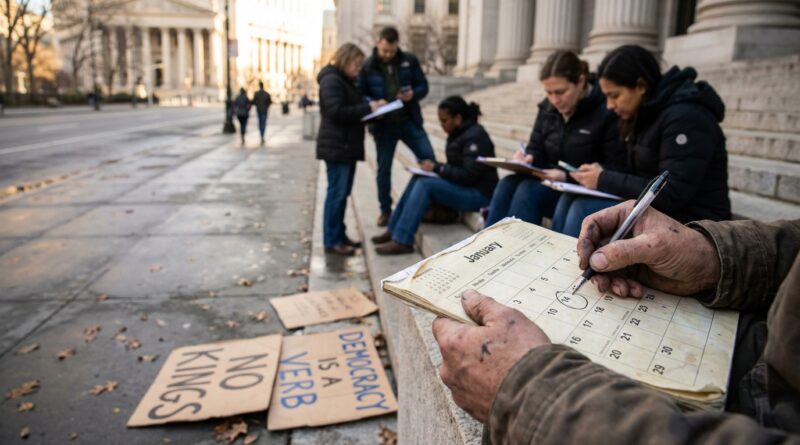
From Marches to Momentum: What Happens After ‘No Kings’ Day Ends?
You did the march. You made the sign. You stood in the heat, chanted until your throat hurt, and felt that rare jolt of being surrounded by people who are just as fed up as you are. Then Monday shows up. The crowd is gone. The headlines move on. And the nagging question creeps in: now what? If you are wondering what to do after No Kings protest energy fades, you are not being cynical. You are being honest. A big public protest can matter, but only if it turns into steady local pressure. The good news is that this next part does not require becoming a full-time activist or memorizing parliamentary rules. It means picking a few concrete actions close to home, then repeating them often enough that elected officials, school boards, county commissions, and state lawmakers feel it. Street energy gets attention. Local follow-through gets results.
⚡ In a Hurry? Key Takeaways
- The best answer to what to do after No Kings protest events is to turn one-day outrage into three repeatable local actions: contact officials, show up in person, and join one group in your zip code.
- Start small. Pick one issue, one meeting, and one weekly habit so you do not burn out by trying to save the whole country before Friday.
- Your safest and most useful move is local, lawful, and trackable. Focus on actions where you can see votes, budgets, policies, and who said yes or no.
The march was not the finish line
A protest is not pointless just because the government did not change overnight. Public demonstrations do a few real things. They show numbers. They help people find each other. They signal that an issue is not going away. They can also make local reporters, donors, organizers, and politicians pay attention.
But a march by itself is mostly a spotlight. It shines. It does not steer. The steering happens later, usually in far less exciting places like city council meetings, county budget hearings, school board comment periods, party precinct meetings, and state legislative offices.
That is the part many people skip, not because they do not care, but because nobody explains the handoff. You went from a crowd of thousands to your couch and a doom-scroll. That gap is where movements lose people.
What to do after No Kings protest: the simple version
If you want a plain answer, here it is. Do these three things in the next seven days.
1. Pick one issue, not twenty
Democracy throws a lot at you. Corruption. Voting rights. Education. Libraries. Reproductive rights. Housing. Immigration. Policing. If you try to carry all of it at once, you will freeze.
Pick one issue that hits home in your town, county, or state. The test is simple: can you name the local people who actually control some part of it? If yes, good. That is your lane for now.
2. Find the room where decisions happen
Every issue has a room. Sometimes it is a city council chamber. Sometimes it is a school board auditorium. Sometimes it is a committee hearing in your state capitol. Find that room. Find the schedule. Put the next meeting on your calendar.
If you cannot attend in person, watch online, submit written comment, or call the office before the vote.
3. Join one existing local group
You do not need to build a new organization from scratch. In fact, that is usually the slowest route. Find one group already working on your issue nearby. It could be a neighborhood coalition, a voting rights group, a public school parent network, a library friends group, a tenants union, or a county-level civic organization.
The goal is not to become best friends overnight. The goal is to stop acting alone.
Three levers you can pull in your own zip code
This is where protest momentum becomes actual pressure. Think of these as your three main tools.
Lever 1: Direct contact with the people in office
Yes, calling and emailing still matter. Not because one email changes a soul, but because volume, timing, and specificity matter. Offices count contacts. Staff notice patterns. Local officials especially notice when messages come from actual constituents and mention a pending vote, policy, or public concern.
Make your message short:
“I live in ZIP code 12345. I attended the No Kings protest because I am concerned about abuse of power and lack of accountability. I want Council Member Smith to vote no on X ordinance and support Y public transparency measure at Tuesday’s meeting.”
That is better than a long angry essay. Give them your location, your issue, and your ask.
Lever 2: Public attendance
Officials behave differently when the room is full. They just do. A half-empty chamber says people are distracted. A packed room says someone is watching.
You do not have to give a dramatic speech. Sometimes simply being there, signing in, wearing the same color, holding the same handout, or standing with ten neighbors sends the message.
If public comment is allowed, keep it calm and factual. Name the item. State the impact. Make the ask. Sit down. That is effective.
Lever 3: Organized local follow-up
This is the glue. One person can make noise. A small group can assign tasks, track votes, divide up calls, bring snacks, and come back next month. That is how “we should do something” becomes “here is what we are doing Tuesday at 6:30.”
Ask any group you join three questions:
- What local decision are we trying to change?
- Who has the power to change it?
- What is the next action on the calendar?
If they can answer those clearly, you found a useful group.
How to avoid the biggest post-protest mistake
The biggest mistake is confusing emotional intensity with strategy. Marches feel huge because they are huge. Local work feels small because it is small. Small does not mean weak.
A school board vote can change what kids read. A county election board can shape voter access. A city budget can move money toward housing, safety, or legal defense. A state legislator can stall or speed up a bill that affects millions.
National politics gets the camera. Local politics gets the keys.
A realistic seven-day plan
If you want something practical, here is a one-week reset.
Day 1: Save your energy
Rest. Hydrate. Put your protest photos somewhere safe. Text the two people you marched with and say, “I want to do one next step this week. Are you in?”
Day 2: Pick your issue
Write down the top three things that made you show up. Circle one that has a local hook.
Day 3: Identify the target
Who controls some part of this issue near you? City council, sheriff, school board, county commissioners, secretary of state, governor, state rep, state senator. Find names, not just titles.
Day 4: Find the next vote or meeting
Search the official site. Look for agendas, calendars, minutes, livestreams, and public comment rules. If the site is messy, call the clerk’s office and ask.
Day 5: Make one contact
Send the email. Make the call. Leave the voicemail. Keep it short and local.
Day 6: Join one group
Not five. One. Show up to the intro call or meeting.
Day 7: Put the next action on your calendar
This matters more than inspiration. If it is not on the calendar, it usually does not happen.
If you are shy, busy, or new to this, you still count
A lot of people think activism only counts if you are loud, fearless, and available every night. That is nonsense. Movements need speakers, yes. They also need researchers, drivers, people who make reminders, people who watch livestreams, people who bring water, people who translate flyers, people who write clean summaries after meetings, and people who quietly make ten calls before lunch.
If crowds drain you, pick a lower-drama role. You can still have impact.
How to tell if your effort is working
Look for boring signs of progress. These are often more real than viral moments.
Good signs
- Officials start responding instead of ignoring you.
- Local media begins covering the issue regularly.
- A meeting agenda changes.
- A vote gets delayed because pressure is building.
- More neighbors start showing up each time.
- A local group gains a clear plan and more volunteers.
Not-so-good signs
- You only engage when there is a giant national story.
- Your group talks endlessly but cannot name the next decision point.
- Everyone is exhausted because every task falls on the same three people.
- No one tracks who voted for what.
Winning is not always immediate. Sometimes progress means making it politically expensive for bad policy to move quietly.
Keep your expectations honest
You are probably not going to fix democratic backsliding by next weekend. That is not a failure. The point is to become harder to ignore than you were before.
Think less in terms of one giant moment and more in terms of pressure over time. Pressure during primaries. Pressure during budget season. Pressure during hearings. Pressure when an official hopes nobody is paying attention.
That is how citizens stop being an audience and start being a problem for people in power.
At a Glance: Comparison
| Feature/Aspect | Details | Verdict |
|---|---|---|
| One-day protest | Builds visibility, morale, and public attention, but usually does not force policy change by itself. | Great spark. Not enough on its own. |
| Contacting local officials | Calls, emails, and testimony tied to a specific vote or issue are easy to repeat and easy for offices to count. | Best first step after marching. |
| Joining a local group | Turns individual frustration into shared plans, repeat attendance, and long-term pressure on decision-makers. | Most sustainable path to momentum. |
Conclusion
If you are asking what to do after No Kings protest events end, the answer is not “wait for the next big march.” It is to turn that energy into a small set of repeatable local habits. Pick one issue. Find the room where decisions happen. Join one group. Contact the people who actually vote on the thing you care about. That may sound less exciting than a giant crowd, but this is the work that keeps communities from slipping back into hopelessness. It helps right now because millions of people are awake and angry, and that can either burn off into doom-scrolling or harden into useful pressure. Moving from “I marched” to “I now have three specific levers I pull in my own zip code” is how you stay in the fight without frying your nerves. National outcomes are built from thousands of local fights. Most of them are boring. Many of them are winnable. Start there.