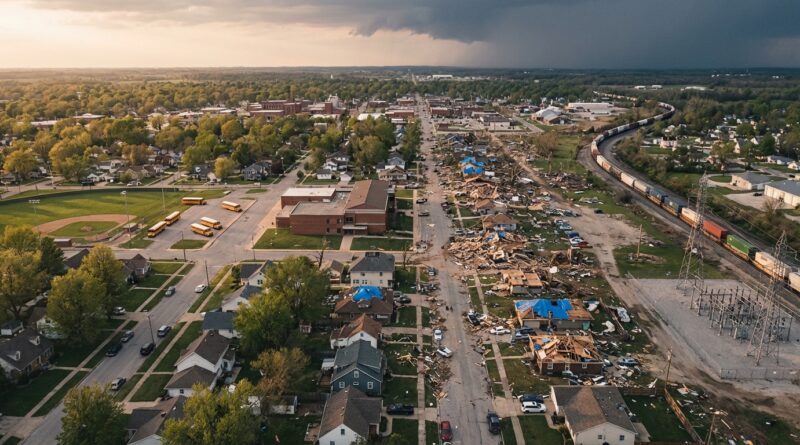
America’s New Climate Shock: How a Spring of ‘Once-in-a-Lifetime’ Disasters Is Quietly Rewriting National Security
It is hard not to feel numb at this point. One week it is tornado sirens. The next it is neighborhoods underwater, roads washed out, power lines down and another map lit up in red. People see the clips, share them, shake their heads and move on. What is easier to miss is the pattern underneath. America is not just having a bad season. It is settling into a new rhythm where “historic” weather keeps arriving before the country has finished cleaning up from the last one. That matters far beyond the forecast. It hits insurance bills, food prices, emergency response, local budgets and the military’s ability to move people and equipment when it is needed most. The real national security story is not one giant catastrophe. It is the pileup. When storms, floods, heat and wildfire all keep coming in waves, the question stops being whether the system can respond once. It becomes whether it can keep responding over and over.
⚡ In a Hurry? Key Takeaways
- Back-to-back US spring storms are no longer just a weather problem. They are becoming a national security problem because they strain emergency systems, infrastructure and military readiness at the same time.
- If you want to understand the risk at home, look beyond the storm itself. Check flood maps, insurance changes, power backup options and how often your area now faces repeat disruptions.
- The biggest danger is not one dramatic disaster. It is constant overload, where FEMA, state agencies, utilities and local governments are always one event away from falling behind.
Why this spring feels different
Americans have always dealt with rough weather. Tornado Alley exists for a reason. River towns have flooded before. Hurricane season has never been gentle. But the feeling now is different because the disasters are stacking.
A tornado outbreak hits. Then severe flooding. Then heat. Then wildfire smoke. Then another round of storms. Recovery used to have a middle. Increasingly, it feels like there is no middle anymore.
That pileup changes the national picture. Emergency workers do not get a full reset. Budgets do not get time to recover. Families cannot rebuild savings between shocks. Roads, bridges, substations and water systems take another hit before the last repair is finished.
How weather became a national security issue
When people hear “national security,” they usually think about war, terrorism, spies or cyberattacks. Fair enough. But national security also means a country’s ability to keep basic systems working during stress.
That includes power. Transportation. Communications. Food supply. Water. Hospitals. Ports. Fuel. And yes, the military.
Climate-driven disasters put pressure on all of them at once. A severe storm can shut down highways, knock out cell towers, flood rail lines and leave hospitals running on backup power. If multiple states are dealing with similar damage at the same time, federal help gets stretched thin fast.
This is where the search term US spring storms climate national security stops sounding abstract. It becomes very practical. Can emergency crews get where they need to go? Can aid arrive quickly enough? Can military bases keep operating if surrounding communities are flooded or without power? Can the government respond to a foreign crisis while also juggling domestic disaster after domestic disaster?
The system was built for a different pace
Much of America’s physical safety net was designed for a climate that no longer exists in the same way. Drainage systems were built around older rainfall assumptions. Levees were built for storms that looked different. Electrical grids were built with certain seasonal expectations in mind. Insurance models leaned on historical data that now feels less reliable every year.
That does not mean every bridge is about to fail or every base is at risk tomorrow. It means the margin for error is shrinking.
The country still has huge strengths. It has skilled first responders, powerful logistics networks and deep technical expertise. But capacity is not infinite. If major disasters become more frequent, the challenge is not only surviving each event. It is handling the cumulative wear and tear.
FEMA is not “failing.” It is being asked to do too much, too often
People often see FEMA after a disaster and come away frustrated. The aid feels slow. The rules seem confusing. The money never sounds like enough. That frustration is real. But part of the story is scale.
FEMA was never meant to be the permanent shock absorber for a country living through repeated billion-dollar disasters all year long. It is trying to support states and local governments that are also under pressure, while Congress fights over spending and communities keep getting hit again.
Think of it like a hospital ER during flu season, except flu season never ends. The staff may still be competent. The problem is constant triage.
Why triage changes outcomes
When agencies are stuck in nonstop response mode, long-term prevention work gets crowded out. Money that should harden infrastructure or improve flood control gets used for debris removal, temporary shelter and emergency repairs. That keeps the country reactive.
And reactive systems are expensive systems.
Why your insurance bill is telling the truth before politicians do
Insurance tends to be one of the first places where climate risk gets translated into plain English. Or rather, plain dollars.
If premiums are rising, coverage is shrinking or deductibles are getting uglier, that is the market signaling that repeated losses are no longer viewed as rare. In many places, the cost of risk is being repriced in real time.
That has security consequences too. If more households become underinsured, disasters leave deeper scars. More people take longer to recover. More homes sit damaged. More local tax bases weaken. More pressure lands on state and federal aid.
So yes, your homeowners policy is personal finance. But it is also part of the national resilience story.
The military is in this story too
The Pentagon has spent years warning that climate stress is a “threat multiplier.” That phrase can sound like government jargon, but the idea is simple. Climate does not replace other threats. It makes them harder to manage.
Military bases can flood. Training gets disrupted by heat. Supply chains can break during extreme weather. National Guard units that might be needed for one mission are pulled into disaster response at home. Ships, aircraft and equipment all depend on stable infrastructure around them.
Then there is the timing problem. A country cannot schedule a geopolitical crisis around storm season. If domestic disasters keep demanding personnel, transport and attention, strategic flexibility starts to narrow.
National Guard overload is the quiet warning sign
The National Guard often becomes the bridge between civilian disaster response and military support. That makes Guard units incredibly valuable. It also makes them vulnerable to overuse.
If floods, tornadoes, wildfires and civil emergencies keep piling up, the Guard can end up everywhere at once. Useful, yes. Unlimited, no.
What “system can’t keep up” really looks like
It probably will not arrive as one dramatic moment where the whole country suddenly stops working. It will look messier than that.
It looks like delayed aid after repeated storms. It looks like roads reopened with temporary fixes that wash out again next season. It looks like hospital systems running near the edge during heat waves. It looks like water plants, dams and substations needing upgrades faster than cities can fund them.
It also looks like normal life becoming more expensive and more fragile. Commutes get less reliable. Grocery prices jump after crop losses. Mortgage lenders become pickier in riskier areas. Local governments spend more on emergency cleanup and less on everything else.
That is how climate stress moves from weather coverage into national security. It changes how a country functions day to day.
What families and communities should pay attention to now
No, most readers cannot rebuild the national grid or rewrite floodplain policy on their own. But you can get much sharper about the risks around you.
1. Study repeat risk, not just headline risk
Ask a simple question. How often has your area had serious disruptions in the last five years? Not just one huge event. Repeats matter more than dramatic one-offs.
2. Treat power as a safety issue
Extended outages affect medication, food, cooling, heating, internet access and emergency alerts. Even a small backup plan helps. That could mean battery packs, stored water, a weather radio or a clear family check-in plan.
3. Read your insurance before you need it
Do not assume “covered” means fully covered. Look at flood exclusions, deductibles, temporary housing rules and replacement cost details. It is boring. It is also one of the most useful things you can do.
4. Watch local infrastructure news
Pay attention to drainage upgrades, dam repairs, wildfire fuel reduction, water restrictions and utility hardening plans. These stories often look dry until the day they become very personal.
5. Build for inconvenience, not just catastrophe
The most likely disruption for many households is not apocalyptic collapse. It is three days without power, a washed-out route to work, a school closure or contaminated water after a storm. Prepare for that level first.
What the country needs to do better
The hard truth is that response alone will not solve this. America has to get better at prevention, hardening and honest budgeting.
That means updating flood maps faster. Building codes need to catch up to current risk. Utilities need more resilience work. Federal disaster policy needs to reward mitigation, not just cleanup. And political leaders need to stop treating every “historic” event like an isolated fluke.
Because if “once in a lifetime” keeps happening every season, the phrase has stopped being useful.
At a Glance: Comparison
| Feature/Aspect | Details | Verdict |
|---|---|---|
| Disaster frequency | Back-to-back spring storms and floods leave less time for recovery between events. | This is the core pressure point. Repetition is the real threat. |
| Government response capacity | FEMA, state agencies and the National Guard can respond, but constant triage weakens long-term resilience work. | Still functioning, but increasingly strained. |
| Everyday impact on households | Higher insurance costs, more outages, mortgage risk, school and work disruptions, and slower recovery after each event. | Already visible. This is no longer a distant problem. |
Conclusion
The big picture is not actually complicated. A string of deadly storms and floods is hitting a country whose emergency systems, infrastructure and budgets were built for a calmer baseline. That is why this matters right now. It helps explain why insurance keeps climbing, why FEMA often seems stuck in permanent response mode and why climate risk now shows up in places people used to think were separate, like mortgages, military planning and local tax bills. Once you connect those dots, the headlines stop feeling random. They become one story about a national safety net aging out of the world it was designed for. That is sobering, but it is also useful. When people can see the pattern clearly, they can push for smarter planning, make better personal choices and stop mistaking a system under strain for a system that can coast forever.