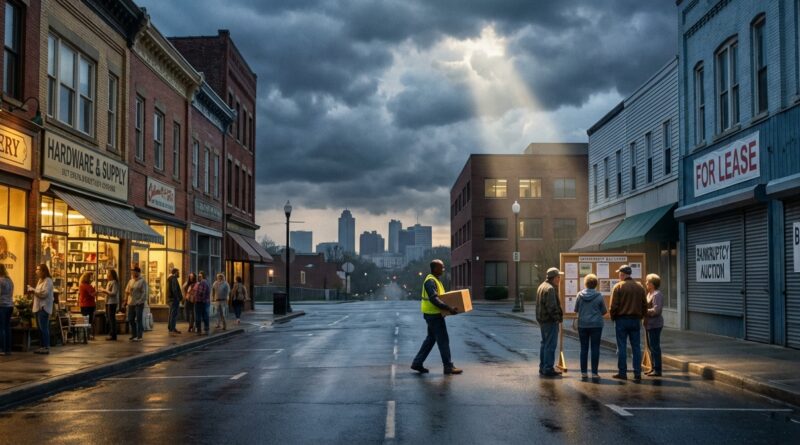
America’s Bankruptcy Wave: How a Quiet Surge in Failed Businesses Could Hit Your Job, Your Town and Your Future
You are not imagining it. When people in your town start whispering about layoffs, when another storefront goes dark, when the family-owned supplier suddenly shuts its doors, it does not feel like a “resilient economy.” It feels like the ground is moving under your feet. That uneasy feeling is often the real economy showing up before the headlines catch up. One of the clearest warning signs right now is the surge in US business bankruptcies in 2026 and what it means for jobs. This is not just a Wall Street problem for traders and CEOs. When more companies run out of cash or can no longer handle debt, the damage spreads outward. Workers lose paychecks. Retirees worry about pensions. Towns lose tax revenue. Local diners, mechanics, and day care centers lose customers. If you want to know what this quiet bankruptcy wave could mean for your job, your town, and your future, here is the plain-English version.
⚡ In a Hurry? Key Takeaways
- A rise in business bankruptcies usually means stress is spreading from company balance sheets to jobs, wages, local stores, and town budgets.
- If your employer, customers, or local economy depend heavily on one struggling industry, start building an emergency cushion and updating your resume now, not after layoffs begin.
- Bankruptcy does not always mean a company disappears overnight, but it is a warning sign that workers, vendors, retirees, and local governments can all get caught in the fallout.
Why this matters more than the stock market chatter
Bankruptcies are one of those business stories that sound distant until they land close to home. A company files. Lawyers get involved. Debt gets reshuffled. News anchors move on.
But in real life, a bankruptcy can mean missed orders for suppliers, reduced shifts for warehouse staff, frozen hiring, delayed payments to contractors, and a lot of anxious families checking their bank accounts at night.
That is why the surge in US business bankruptcies in 2026 matters. It can be an early signal that high interest rates, sticky prices, weaker demand, and global conflict costs are all squeezing firms at the same time. Some businesses can absorb that. Others cannot.
What a business bankruptcy actually means
“Bankruptcy” is not just a fancy word for “closed forever.” Think of it more like a company pulling the emergency brake.
Sometimes it means reorganization
In some cases, a company keeps operating while it tries to cut debt, close weaker locations, and buy time. Workers may still have jobs for a while, but conditions often get rough. Benefits can change. Expansion plans get canceled. Vendors may be paid late.
Sometimes it means liquidation
In other cases, the business is done. Stores shut. Equipment gets sold. Staff are let go. For the town around it, the effect can last much longer than the company itself.
That is the key point most national coverage misses. Bankruptcy is not a legal event only. It is a community event.
Why bankruptcies are rising now
There is rarely one single cause. Usually it is a stack of problems that finally gets too heavy.
High interest rates
When borrowing costs stay high, companies that relied on cheap debt get hit hard. Refinancing old loans becomes more expensive. Expansion plans stop making sense. Cash that used to go toward hiring or inventory goes toward interest payments instead.
Lingering inflation
Even if inflation is lower than its peak, many businesses are still paying more for rent, labor, insurance, fuel, shipping, and materials. If customers are already stretched, companies cannot always pass those higher costs along.
War and global instability
Wars and regional conflicts affect shipping routes, energy prices, raw material costs, and investor nerves. Businesses far from the battlefield still feel the cost. That pressure trickles down into prices, margins, and hiring.
Consumers are more cautious
People may still be spending, but many are spending more carefully. Households facing high credit card balances, rent, groceries, and insurance costs cut back on extras first. That hurts restaurants, retail, travel, home upgrades, and small service businesses.
How this hits jobs first
If you are wondering about the surge in US business bankruptcies 2026 and what it means for jobs, the answer is simple. Jobs usually feel the pressure before the official numbers tell the whole story.
Layoffs are not always immediate
Companies often try smaller cuts first. Open positions go unfilled. Overtime disappears. Contractors are let go. Hours are reduced. Travel freezes. Raises get delayed.
That is why people in a town often sense trouble before economists do. You see it in canceled shifts, not just in spreadsheets.
One bankruptcy can trigger others
If a large local employer goes under or sharply cuts back, nearby businesses lose customers. The coffee shop near the plant suffers. So does the print shop, the gas station, the child care center, and the landlord with half-filled units.
That is how a bankruptcy wave spreads through a region. Not like a movie explosion. More like a slow power outage.
What it can do to your town
Local economies are more fragile than they look. A handful of employers often support far more than people realize.
Less tax revenue
When businesses close or shrink, towns collect less in taxes and fees. That can affect road repairs, library hours, public safety staffing, parks, and school support.
Empty commercial space
Dark storefronts change how a place feels. They also make nearby properties harder to fill. Once a shopping strip starts to look unstable, foot traffic falls and the next struggling business has an even harder time surviving.
Population drift
If enough good jobs disappear, younger workers move away. That means fewer customers, fewer families in schools, and less momentum for the whole area.
The part retirees and workers should not ignore
Bankruptcy can also hit people who thought they were safely removed from business risk.
Pensions and retirement plans
If a company is in serious trouble, retirement promises can come under stress. Not every bankruptcy destroys pensions, but it can create delays, cuts, confusion, or a lower sense of security.
Severance and unpaid wages
Workers sometimes assume severance is guaranteed. It may not be. In bankruptcy, many people line up to get paid, and employees are not always made whole quickly.
Health coverage
Job loss often means benefit loss. That can turn a business failure into a family crisis fast, especially if someone has ongoing medical needs.
Who should be paying closest attention
Some people are more exposed than others.
- Workers in industries already carrying heavy debt
- People employed by companies with falling sales and recent cost cuts
- Small business owners whose biggest customer is one large local firm
- Retirees relying on benefits tied to troubled employers
- Towns built around one hospital, factory, chain retailer, or logistics hub
If that sounds like your situation, this is not the time for panic. It is the time for clear-eyed preparation.
What you can do right now to protect yourself
1. Build a bigger cash buffer if you can
Even a small emergency fund matters. Start with one month of bare-bones expenses if that is all you can manage. The point is breathing room. Bankruptcy shocks hurt most when families have no time to adapt.
2. Update your resume before you need it
Do it now, while you are calm. Add recent projects, skills, and results. Reconnect with former coworkers. Quietly check what employers in nearby towns or industries are hiring for.
3. Watch for early signs at work
Late vendor payments, hiring freezes, sudden travel cuts, postponed bonuses, nervous managers, and talk of “restructuring” are all signs worth taking seriously.
4. Cut fixed costs where possible
People often focus only on income. Expenses matter too. If you can lower a subscription stack, refinance something expensive, or reduce a monthly bill, that gives you more resilience.
5. Do not depend on one customer or one employer if you can avoid it
If you run a small business, a bankruptcy wave can be brutal when too much of your revenue comes from one struggling client. Start widening that base before you are forced to.
6. Ask better questions in your community
How dependent is your town on one employer. What industries are growing nearby. Are local officials talking openly about vacancies, tax shortfalls, or development delays. Local reality often shows up first in school board meetings, county reports, and chamber of commerce chatter.
How to read the warning signs without spiraling
There is a balance here. You do not want to ignore trouble, and you do not want to assume every bankruptcy means a national collapse.
Think of it like seeing smoke. One small kitchen fire is one thing. Smoke rising from several buildings across town is something else. A broad rise in bankruptcies tells you stress is spreading. It does not tell you every company is doomed.
The smart response is practical, not dramatic. Save more. Stay informed. Keep your options open.
Why this trend feels “quiet” until suddenly it is not
Big economic shifts often begin in ways that are easy to dismiss. A local closure here. A delayed project there. A bigger discount sign in the store window. Then, one day, people realize the pattern has been building for months.
That is why situational awareness matters. By the time cable news turns a bankruptcy wave into a nightly theme, many communities have already been living it.
At a Glance: Comparison
| Feature/Aspect | Details | Verdict |
|---|---|---|
| Job impact | Bankruptcies often lead to hiring freezes, reduced hours, layoffs, and weaker wage growth before official data fully reflects the damage. | High risk for workers in debt-heavy or slowing industries. |
| Local community effect | Store closures, lower tax revenue, empty properties, and fewer customers can weaken the broader town economy. | Main Street feels it fast, especially in smaller towns. |
| Best personal response | Build savings, update your resume, reduce fixed costs, and avoid overreliance on one employer or customer. | Preparation beats panic every time. |
Conclusion
The growing wave of US bankruptcies is one of the clearest signs that the costs of war, high interest rates, and lingering inflation are starting to bite. The problem is that too much coverage treats it like a Wall Street side story when it is really a Main Street warning. It can affect jobs, pensions, local services, and the stability of whole towns. The good news is that seeing the pattern early gives you options. You can build a cash cushion, tighten your monthly budget, keep your skills current, and pay closer attention to what is happening around you. That kind of awareness is not pessimism. It is practical self-defense. When the ground is shifting fast, the people who do best are not the ones who guessed every headline correctly. They are the ones who noticed what was changing and got ready in time.